Tag, throw-up, piece, wildstyle: graffiti styles explained
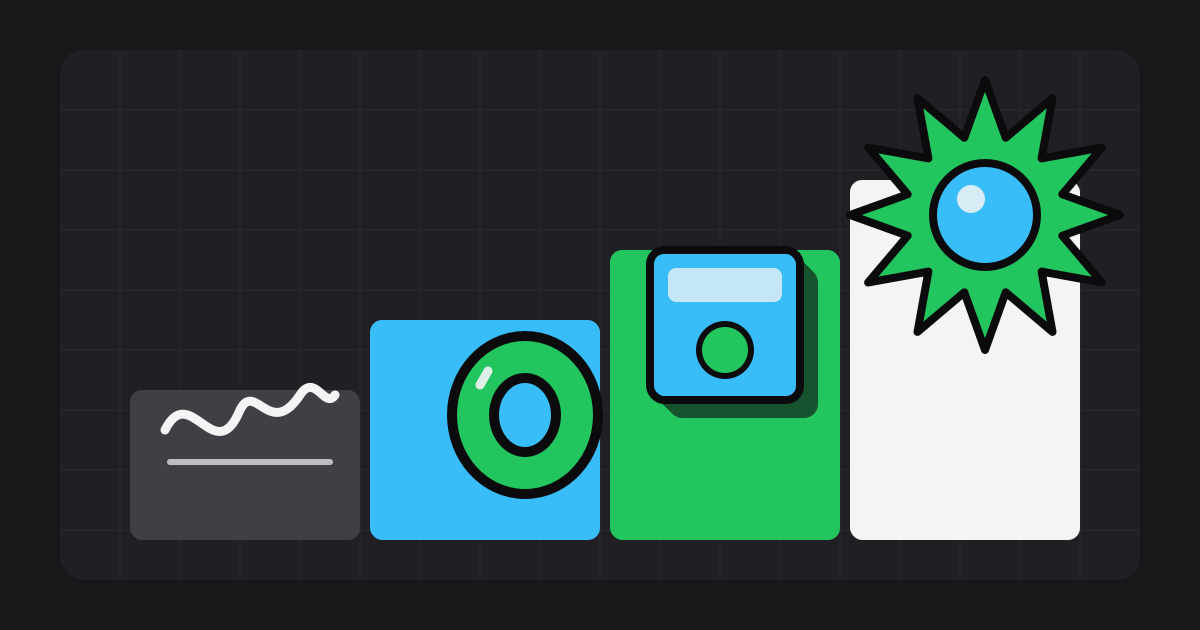
A tag takes seconds, a throw-up a few minutes and a piece a full session, and all three are graffiti. Knowing which rung you are standing on tells you what to practise, how many colours to bring and how much planning the work needs.
Walk along a long wall and you see every form at once: quick signatures at head height, fat two-colour letters near the corners and one big colourful work in the middle. The names are not decoration. They are how writers talk about speed, skill and ambition.
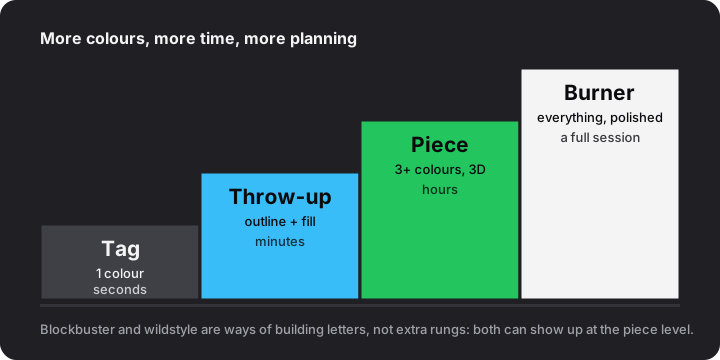
The ladder at a glance
| Form | What it is | Colours | Rough time | Style to start from |
|---|---|---|---|---|
| Tag | A stylised signature, the simplest form | One | Seconds | Wire Frame, Spray Stencil |
| Hollow | A throw-up that is only an outline, no fill | One | Under a minute | Wire Frame |
| Throw-up | A quick outline plus fill, usually in bubble letters | Two | A few minutes | Throw-Up, Bubble Pop |
| Piece | A large multi-colour work with 3D effects, highlights and a background | Three or more | Several hours | Block 3D, Chrome Metal, Gold Royal |
| Burner | An elaborate piece that seems to burst off the wall | Many | A full session or more | Block 3D on a bold background |
The times are my rough rules of thumb for a confident writer, not a standard. They shift with wall size, weather and how much you planned. The definitions follow the glossary of graffiti terms.
Tag: your signature in one colour
A tag is a name written as a fast, stylised signature, usually in one colour. It is handwriting turned into a logo. The skill is flow and consistency: your tag should come out almost identically the hundredth time.
- Pick a short name. Choose letters you enjoy drawing. Crews usually shorten theirs to 2 to 5 letters, such as the invented crew DNK.
- Practise with a pen on paper. Write it a hundred times at speed, circle the three best and redraw those slowly.
- Keep it yours. A name or style already used by someone nearby counts as biting.
Throw-up and hollow: speed with a clean shape
A throw-up (also called a throwie) is a quick outline plus a fill, nearly always in rounded bubble letters. A hollow is the same shape with the fill left out, so it is faster still. What matters here is a clean shape done in one pass, not detail.
My advice: learn the hollow first. If the outline is good, the fill takes care of itself. The construction rules (even thickness, open counters, overlap order) are in the guide to drawing bubble letters step by step.
Piece and burner: planned, multi-colour work
A piece, short for masterpiece, is a large multi-colour work with 3D effects. A burner is a piece with so much polish that it seems to burst off the wall. You do not improvise these. They begin in a black book:
- Sketch the letters in pencil and decide the connections between them.
- Ink the outline and add the 3D block in one consistent direction.
- Test two or three colour schemes on small copies.
- Add highlights, a background and extras such as stars or drips.
- Only then think about scaling it up, on paper, canvas or a permission wall.
Colour and depth carry most of the weight, which is why 3D letters and colour schemes get their own guide.
Blockbuster and wildstyle: two ways to build letters
A blockbuster is big, simple, legible letters, often rolled on in two colours. It is made to be read from far away, which is exactly why you see it on large walls.
Wildstyle goes the other way. The letters interlock, stretch, split and carry arrows and connections, so the word becomes hard to read on purpose. It is written for other writers, who read it like a puzzle. If you cannot read a wildstyle piece, it is working as intended.
Be honest about what a computer can do here. The Wildstyle-like style in the generator is only an approximation: overlap, tilt and arrows get you closer to the look, but real wildstyle is built by hand, letter by letter, from letters you already know how to construct. Learn the legible version first, then bend it.
Words you will hear
| Word | Meaning |
|---|---|
| Fill | The colour inside the letters |
| Outline | The line around the letters |
| 3D, block | The sides that make a letter look solid |
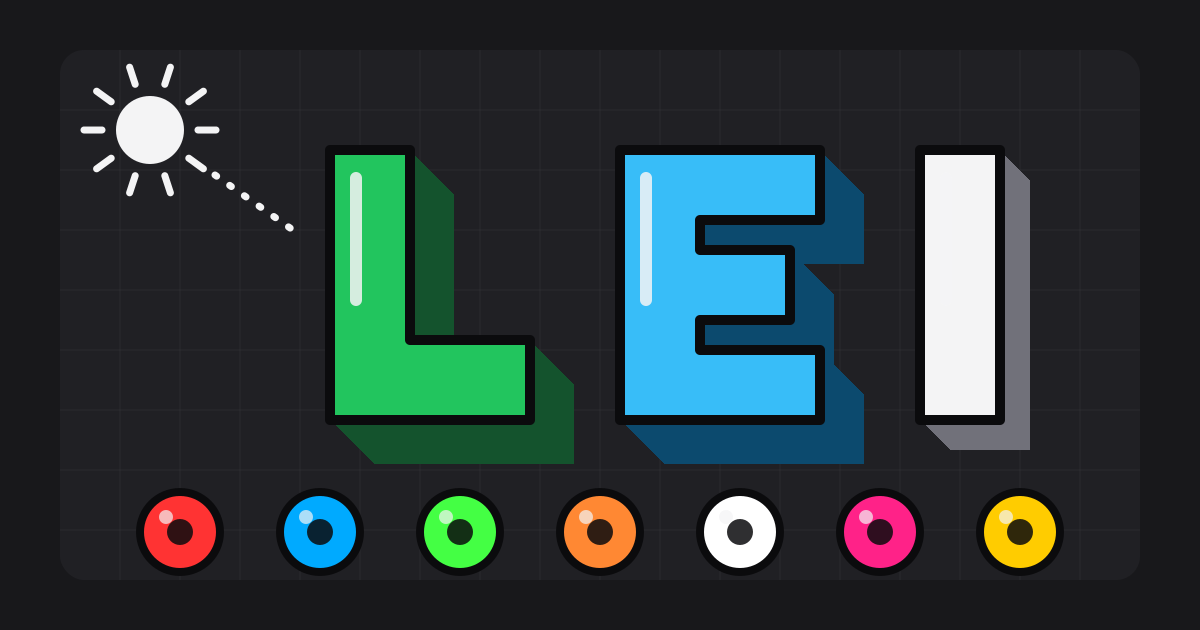
| Highlight, shine | Light marks on the lit side of a letter |
| Arrows | Pointed extensions on wildstyle letters |
| Black book | The sketchbook where pieces are planned |
| Legal wall | A wall you may paint because the owner agrees |
| Buff | Removal or painting over of a work |
| Biting | Copying another writer's name, letters or colours |
| Toy | Usually a beginner, or work that looks unpractised |
| King | A writer widely respected in an area |
Etiquette and legal walls
Writing on property without permission is illegal in most places. I keep my own practice on paper, canvas, boards and legal walls, and I tell every beginner to do the same. A legal wall is simply a space where the owner agrees you may paint; many towns have a few, and some paint shops know where.
- Ask first, always, and keep to the area you were given.
- Do not paint over other people's work on a legal wall unless it has clearly been abandoned.
- Do not bite. Build your own letters.
- Expect buffing. Nothing on a wall lasts, so photograph what you want to keep.
Using the generator for each form
A graffiti generator is a sketch tool: it shows how your word looks in each form so you can redraw it in your own hand style. Here is where I would start:
| If you are practising | Try | What to study |
|---|---|---|
| A tag-like signature | Wire Frame, Spray Stencil | Letter shapes and spacing, in one colour |
| A throw-up | Throw-Up, Bubble Pop | Outline thickness and overlap |
| A piece | Block 3D, Chrome Metal, Gold Royal, with a background | Direction of the 3D block and colour contrast |
| Drips | Drip Paint | Length and spacing of the drips |
| A wildstyle-like start | Wildstyle-like | Where letters could connect; then redraw them by hand |
Practise tag, then hollow, then filled throw-up, then a simple piece. Skip a rung and the next one gets harder.
FAQ
What is the difference between a tag and a throw-up?
A tag is a quick stylised signature, usually in one colour. A throw-up is a fast outline plus fill, usually in bubble letters, so it is larger, rounder and uses at least two colours.
What is a burner in graffiti?
A burner is an elaborate piece that seems to burst off the wall. It is a piece pushed to the limit: many colours, 3D, highlights and a strong background.
Why can't I read wildstyle graffiti?
The letters interlock, stretch and carry arrows, so they are deliberately hard to read. It is made for other writers, who read it like a puzzle.
Where can I practise graffiti legally?
On paper, canvas or boards, and on legal walls where the owner agrees to paint. Writing on property without permission is illegal in most places.
Which graffiti form should a beginner learn first?
Start with a tag on paper, then hollow throw-ups, then filled throw-ups. Move to a simple piece after your outlines are clean.